 By OUR CORRESPONDENT
Muscat – Oman’s universities are moving beyond traditional classroom teaching towards industry-linked education, applied research and entrepreneurship as the country prepares its workforce for a more technology-driven, knowledge-based economy.
A new report produced by Oxford Business Group in partnership with the University of Technology and Applied Sciences (UTAS) examines how higher education is evolving to support workforce development, applied research, entrepreneurship, digital transformation and sustainable growth.
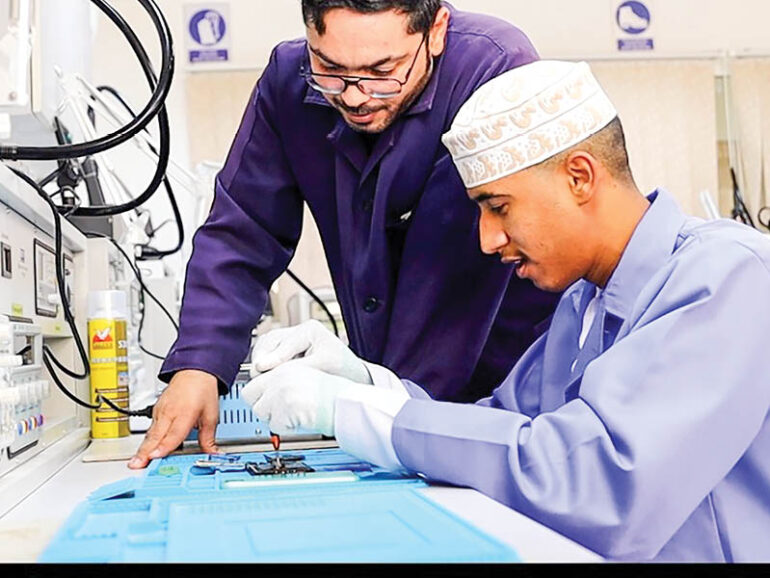
The report says institutions are increasingly redesigning courses around labour-market needs, integrating work experience into study programmes and involving employers in curriculum development.
The shift comes as Oman’s economic diversification plans target 300,000 new jobs between 2026 and 2030 and a 56% private-sector contribution to GDP by 2030, increasing pressure on universities to produce graduates with skills relevant to manufacturing, logistics, renewable energy and the digital economy.
Artificial intelligence, data analysis, digital systems and sustainability are emerging as key areas, alongside critical thinking, creativity, communication and adaptability.
Saeed Hamad Al Rubaie, Vice-Chancellor of UTAS, said universities were shifting “from providers of knowledge to contributors to workforce development, innovation and long-term economic competitiveness”.
UTAS, Oman’s largest higher education institution with more than 45,000 students, illustrates the scale of the transformation. Created in 2020 by merging technology and applied sciences colleges, it now operates 11 branches across the country under a unified system. Its programmes increasingly combine teaching with applied research, industry projects and entrepreneurship.
By 2025, UTAS had recorded 364 student start-ups and reached 89% digital maturity, while programmes are being aligned with sectors including energy, ICT and creative industries.
Research is also taking a larger role. Oman had five universities in the QS World University Rankings 2026, up from two a year earlier, while research publications by Omani higher education institutions increased 36.9% in 2024. National research and development expenditure rose 26% between 2022 and 2023.
Universities are also building stronger links with global research and professional networks. UTAS works with organisations including Cisco, IEEE and the International Atomic Energy Agency, while more than 10,000 students received digital-skills training through its Cisco partnership in 2024.
The report argues that the next phase will depend increasingly on how effectively universities convert education and research into employable skills, innovation and commercial opportunities, making higher education a direct component of Oman’s economic diversification rather than simply a pathway to a degree.
© 2021 Apex Press and Publishing. All Rights Reserved. Powered by Mesdac